Scale2Boss is one of those projects that usually goes deeper than a studio is comfortable with. Most web projects end at the website. This one only began there. What ended up shipping was not a website but a complete product, with its own identity, its own sales platform, and an AI architecture orchestrating 12 agents in the background.
The project is special to us for another reason. Our founder Benjamin Zekavica is also a co-founder of Scale2Boss, which he built together with Thorsten Carl. Thorsten developed the marketing system at the heart of Scale2Boss across 27 years of practice. In a regular client engagement, the lack of distance would be a problem. Here, it was the point. Kreo Pulse applied its own method to its own product, with the kind of standards that only kick in when your own name is on the line.
The Starting Point
Thorsten brings 27 years of marketing practice, more than 600 client engagements, and seven-figure revenue from direct sales. Benjamin brings 15 years of IT and web design, his work on the WordPress Core Team, and the experience from Kreo Pulse of building digital infrastructure for companies.
Their hypothesis was straightforward. Self-employed professionals in the German-speaking market are missing something between generic AI and premium coaching: a system that thinks like a seasoned marketer and operates like a tool. What was missing was everything else. No name. No identity. No technical foundation.
That is where Kreo Pulse stepped in.
Phase 1: Identity
The color palette was the toughest decision of the entire phase. The audience is used to premium coaches, so anything that looked cheap was out. At the same time, we wanted to stay clear of the gold tone that has become a signature for every other marketing brand.
We landed on a muted bronze paired with pure white. The bronze carries the premium feel without tipping into kitsch. White takes on the role of technical clarity, which is what defines the product on the inside.
The logo itself uses an S that reads as an upward arrow on a second look. The mark needed to work in three seconds on a business card and still hold up in a three-minute pitch deck.
The visual language stays quiet on purpose. Dark backgrounds with few accents, no stock photography, no generic AI visuals. When someone lands on scale2boss.com, the product should feel like it speaks for itself.
Phase 2: Online Presence
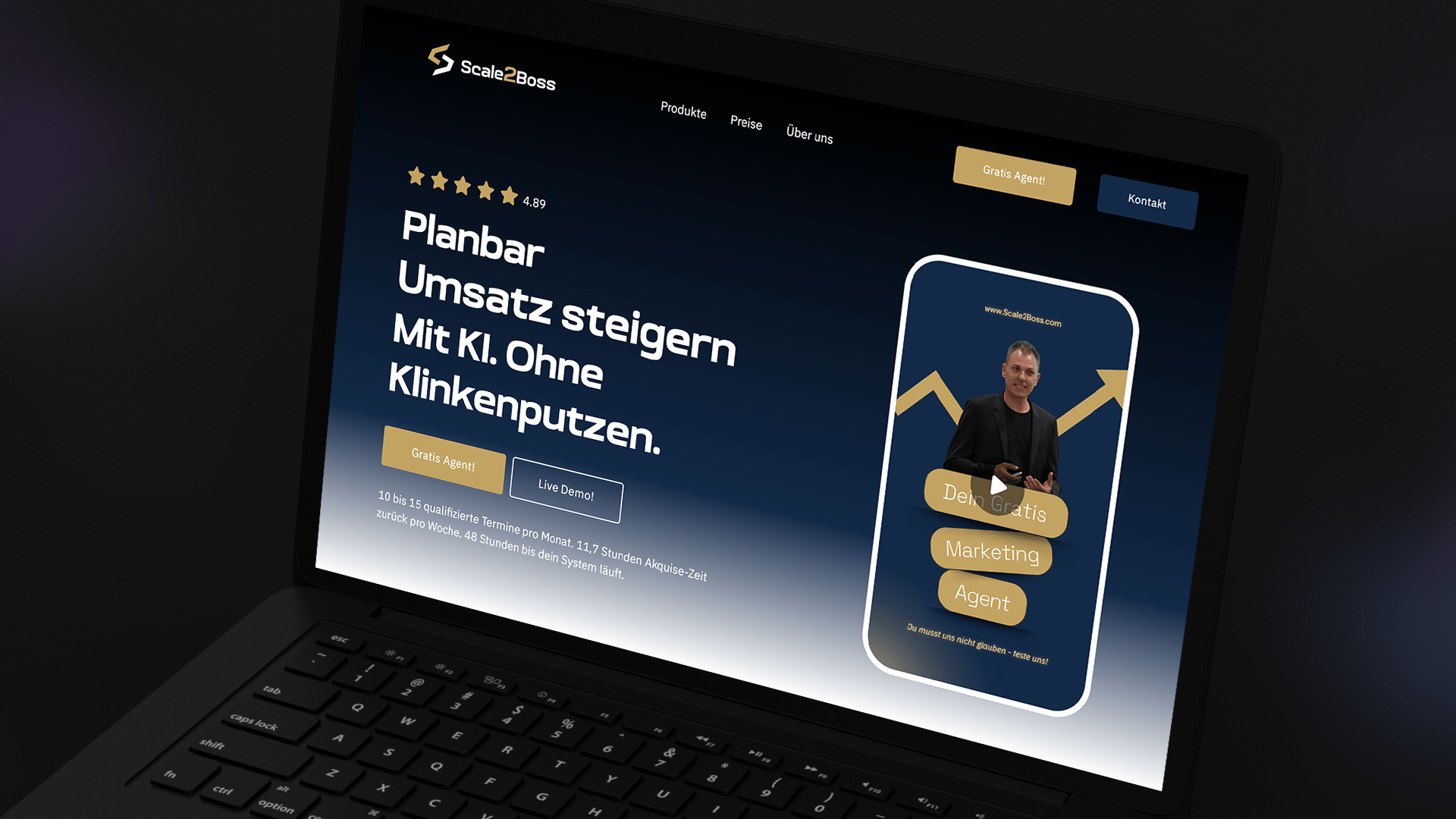
scale2boss.com is a sales platform. We defined that early because the decision shaped everything that followed. An image-driven website has a different job than a sales page. It tells someone who a company is. A sales platform takes someone who has never heard of the company and walks them to a buying decision. The decisions on every section of the site flow from that distinction.
The header had to surface the audience’s pain in a single line, otherwise nobody scrolls. The middle section unpacks the product along a logic the reader can map in their head. The founder section builds trust through the combination of marketing experience and engineering background. The pricing section was about readability, because the offer is priced unconventionally.
On the technical side we focused on three things. Speed was one, because every second of load time costs conversion. Funnel stability was another, since a broken checkout burns revenue directly. The third was a clean tracking setup from day one, so the team would know early what was working.
Phase 3: The Product
This is where it gets unusual. Most studios stop after Phase 2. With Scale2Boss we started over here.
The product runs on 12 specialized agents and 50 modules that together form a continuous workflow. Every agent has its own job. The research agent reads the market. The strategy agents build positioning and funnel. The execution agents produce copy, hooks, and sales scripts. The 50 modules are the building blocks each of these agents pulls from.
What makes the architecture demanding is the platform it runs on. AI products behave differently than classic software. A module has to fire reliably even when the user phrases the request in unexpected language. An agent cannot lose context across multiple steps. And the output has to land in formats the user can actually work with, like PDF and DOCX rather than screen-only display.
For each of these requirements, a solution runs in the background that the buyer never has to see. What they experience is a workflow that feels like a human thought it through.
What We Take Away
Three observations from the project that will shape future work.
Identity, web, and product need to come from one head. Once three separate vendors are involved, the clarity a good product requires gets lost. This is not an ego argument, it is an efficiency argument. The translation losses between branding agency, web studio, and product developer cost more time and quality than a studio that covers all three disciplines.
AI-native product development has become its own discipline. A ChatGPT wrapper around an idea produces a demo, not a product. What actually holds up emerges when the underlying platform is understood and the architecture is shaped around it.
The distinction between a sales platform and an image-driven website is one that few studios draw cleanly. Anyone who orders a sales page and ends up with an image-driven website will eventually wonder why the conversion rate is off.
If You Are Working on Something Similar
A new identity with a matching online presence. A website that no longer holds up. A product idea that others say should really be possible with AI. We will take it on.